

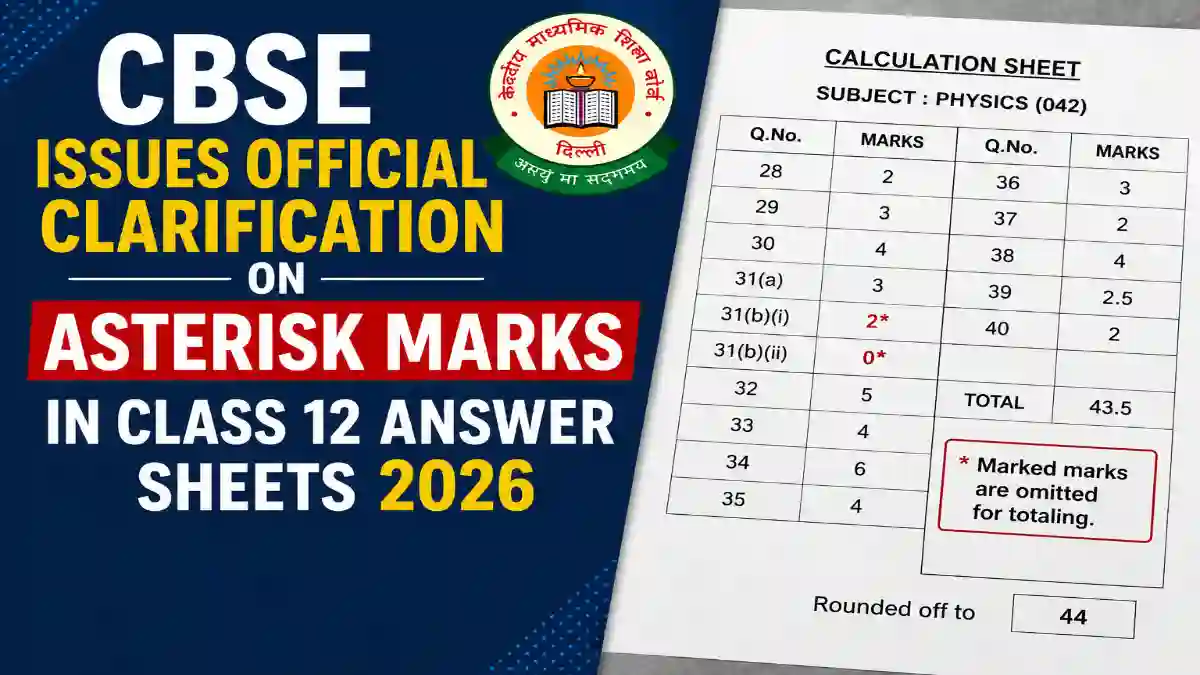
Central Board of Secondary Education (CBSE) issued a formal clarification regarding asterisk marks appearing on Class 12 answer-sheet calculation sheets, assuring students that the difference between certain question-wise scores and final totals is intentional and part of the Board’s established evaluation policy.
The clarification, issued vide Circular No. CBSE/COORD/TOTALING/CLASS XII/2026 and signed by Dr. Sanyam Bhardwaj, Controller of Examinations, came after the Board received a significant number of queries from students who had accessed scanned copies of their evaluated answer books and noticed that some marked scores were not reflected in their final totals.
How Does CBSE’s Over-Attempt Evaluation Policy Work?
CBSE question papers for Class 12 contain internal choices in several questions, allowing students to attempt one of the given options. However, some students attempt both options, a situation the Board refers to as an “over attempt.”
As per CBSE’s evaluation policy, when a student over-attempts a question, only the higher of the two scores is considered for the final total. The marks awarded for the other attempted option or sub-part are not included in the final score.
What Does the Asterisk Mean in CBSE Class 12 Answer Sheet?
To indicate which marks have been excluded from the total, CBSE places an asterisk next to those scores along with a footnote stating that the marked scores have been omitted for totaling purposes.
According to the Board, many students who accessed scanned answer books were unaware of this practice and assumed that the asterisked marks had been omitted incorrectly, leading to a large number of queries.
How are the best marks selected in Over-Attempted Questions?
In the circular, CBSE provided an example to explain the process. If a student attempts both options in a question carrying internal choice and scores 3 marks in one option and 2 marks in the other, only the higher score of 3 marks is counted in the final total. The lower score is marked with an asterisk and excluded from the calculation.
The Board stated that this method ensures that students receive the benefit of the higher score while maintaining the prescribed marking scheme.
Why Are Students Seeing Differences Between Question-Wise Marks and Final Totals?
The clarification assumes significance this year as more students have accessed digital copies of their evaluated answer books. While the initiative has increased transparency, it has also led to confusion among students, seeing question-wise marks for the first time and manually calculating totals without considering asterisked entries and explanatory footnotes.
CBSE Official Clarification
In the circular, the Board advised students to carefully review the asterisk marks and accompanying footnotes before calculating their scores manually.
“Hence, all candidates are requested to see the asterisk mark and the footnote given before calculating the total marks obtained and shown on the calculation sheet,” the circular stated.
What Should Students Do?
Students who have received scanned copies of their answer books should first identify any asterisked marks and read the accompanying footnote. They should then verify whether the higher score from an over-attempted question has been included in the final total.
CBSE has advised students to raise a formal query only if the higher score has not been considered after reviewing all asterisked entries.
Key Facts: CBSE Clarification on Asterisk Marks 2026
- Circular Number: CBSE/COORD/TOTALING/CLASS XII/2026
- Date of Issue: June 4, 2026
- Issued By: Dr. Sanyam Bhardwaj, Controller of Examinations
- Applicable To: CBSE Class 12 students
- Policy: Higher score counted in case of over-attempted questions
- Excluded Marks: Indicated with an asterisk and explanatory footnote
CBSE reiterated that the presence of an asterisk on the calculation sheet should not be interpreted as a totaling error and that the final marks awarded remain valid under the Board’s evaluation guidelines.