

10 Steps to Choose the Right Career After Class 12
Choosing the right career after Class 12 is one of the most important decisions in a student’s life. With thousands of courses, colleges, and career options available today, making the right choice requires more than just good marks it requires the right skills and guidance.
At the core of every successful career decision lies API Alignment: Aptitude, Personality, and Interest. Aptitude reflects your natural strengths and abilities, Personality determines the kind of work environment and goals that suit you, and Interest represents the activities and subjects that genuinely engage you. When these three factors align, students are more likely to choose a career path that is both fulfilling and sustainable.
In this article, we will explore the key skills every student should develop to understand their API Alignment and make informed career decisions with confidence.
Analyze Skills by Stream
| Streams | Required Skills | Top Courses |
| Science (PCM) | Logical reasoning, tech skills | Engineering, Architecture, Data Science |
| Science (PCB) | Memory, observation, ethics | MBBS, BDS, Pharma, Biotech, Psychology |
| Commerce | Numeracy, business sense, communication | B.Com, BBA, CA, CS, Economics |
| Arts/Humanities | Writing, empathy, critical thinking | BA, Journalism, Law, Psychology, Design |
| Vocational | Creativity, hands-on skills, digital | Fashion, Animation, Hotel Mgmt, Aviation |
How to choose the right course
1. Self-Awareness and API allignment
The API Alignment Process: Finding the Right Career Fit
Choosing the right career after Class 12 is not about following trends or selecting the most popular course. The best career decisions happen when you are self aware and for self awareness comes in three important factors align: your Aptitude (Capabilities), Passions (Interests), and Identity (Personality & Values). This is known as API Alignment.
A student may have strong aptitude for mathematics, but if they have little interest in technical problem-solving, a career in engineering may not provide long-term satisfaction. Similarly, someone may be passionate about helping people but lack the aptitude required for a highly specialized medical profession. This is why successful career planning requires balancing all three elements rather than focusing on just one.
How the API Alignment Process Works
The API framework can be applied through a simple filtering process:
Step 1: Understand Your Profile
Begin by identifying your strengths, interests, personality traits, and values. Ask yourself questions such as:
- What subjects do I naturally perform well in?
- What activities keep me engaged for long periods?
- Do I enjoy working with people, data, technology, or creative ideas?
- What matters most to me in a career—stability, creativity, impact, or financial growth?
Step 2: Filter Career Options
Once you understand your profile, evaluate career options based on three key criteria:
- Aptitude Match: Do you possess the abilities required for success in that field?
- Interest Overlap: Will you enjoy the day-to-day work involved?
- Values Alignment: Does the career support the lifestyle and goals that matter to you?
The careers that satisfy all three criteria are usually the strongest long-term options.
Tools That Can Help You Measure Your API
While self-reflection is valuable, many students struggle to assess themselves objectively. This is where scientific career assessment tools can help.
- Aptitude Tests evaluate reasoning ability, problem-solving skills, and cognitive strengths.
- Personality Assessments identify work styles, behavioural traits, and leadership potential.
- Interest Inventories help discover career fields that naturally match your preferences and motivations.
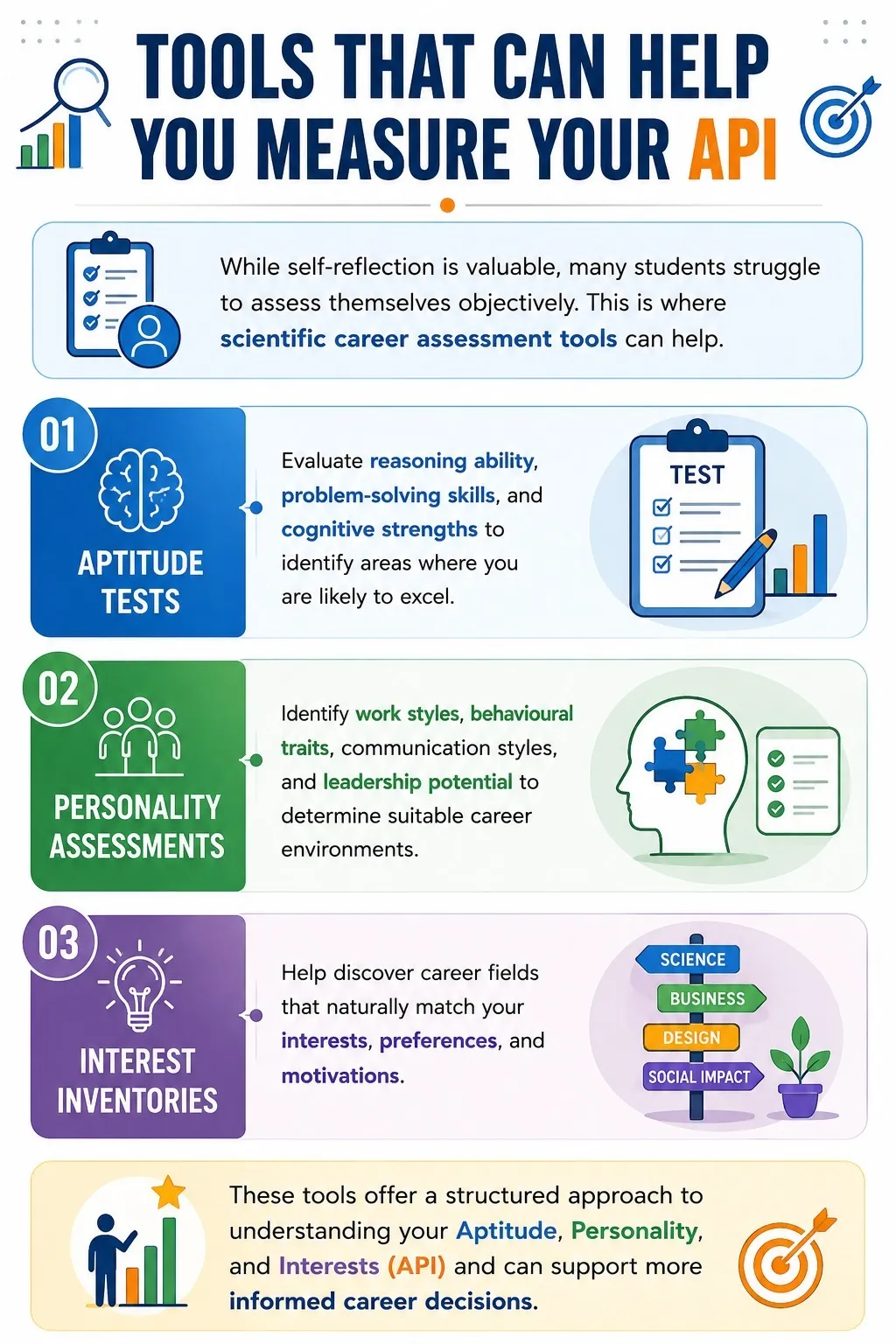
These tools provide a clearer picture of who you are and which career paths are most likely to suit you.
Why API Alignment Matters
Research consistently shows that students who choose careers aligned with their abilities, interests, and values are more likely to experience higher job satisfaction, stronger performance, and better long-term career stability.
Instead of choosing a degree solely based on salary trends or peer pressure, API Alignment encourages students to make informed decisions that support both professional success and personal fulfilment. After all, you are not just choosing a college course you are choosing a career path that may shape the next 40 years of your life.
2. Research and Analytical Skills
Research and analytical skills help students go beyond memorizing facts — they enable true understanding of academic subjects and their practical applications. Whether you’re solving a math problem, writing a history essay, or conducting a science experiment, these skills allow you to dig deeper, ask the right questions, and apply concepts in real-life or exam scenarios.
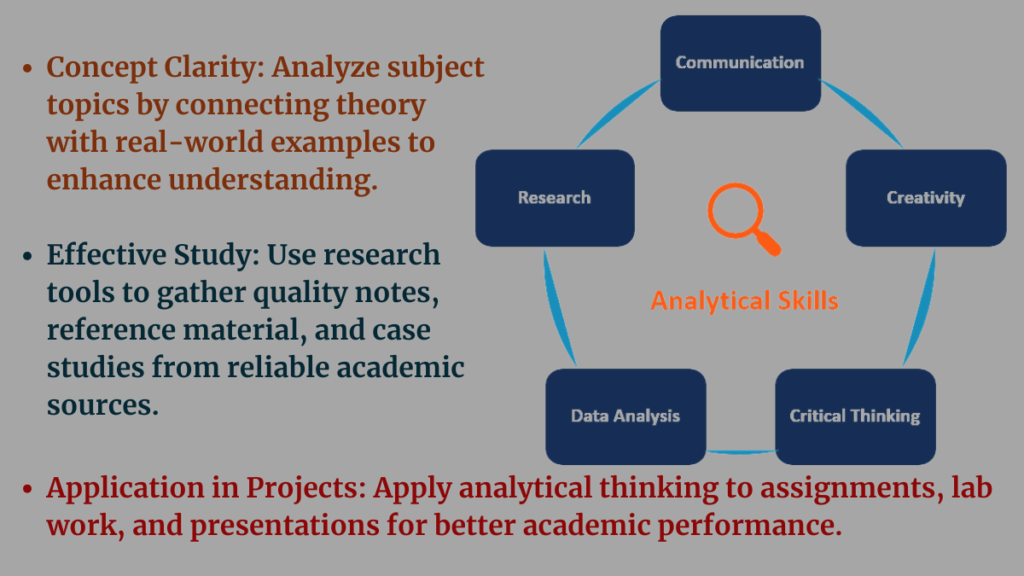
Engineering, mathematics, and science courses require a lot of critical thinking and the ability to break down complex concepts into simpler ones. These skills are highly valued in both academic and professional environments.
3. Critical Thinking and Decision-Making
Critical thinking and decision-making are vital academic skills that help students assess information, weigh multiple viewpoints, and make independent, informed choices. These skills are especially important when tackling complex problems, choosing subjects or electives, or evaluating feedback — ensuring that students don’t just follow the crowd but think for themselves.
- Solve Academic Problems: Apply structured thinking to case studies, debates, and problem-solving tasks across all subjects.
- Evaluate Information: Learn to question assumptions, spot biases, and assess credibility of study material or advice.
- Make Informed Choices: Use logic and reasoning to choose the right subjects, projects, or career paths aligned with your goals.
4. Creativity and Innovation
If you are considering courses in Design, Fine Arts, Animation, Journalism, or Fashion, creativity is an essential skill. Creative thinking allows you to bring unique perspectives, innovative ideas, and original work to the table. Courses such as Architecture, Graphic Design, and Media Studies demand a high level of creativity. In these fields, you are often expected to not only think outside the box but also bring new ideas to life using your artistic and problem-solving skills.
Building creativity involves:
- Engaging in creative hobbies
- Learning new techniques
- Observing the world around you
- Taking inspiration from different art forms
5. Communication Skills
Good communication skills are essential for success in almost every field. Whether you pursue a career in:
- Business (Marketing, HR, Finance)
- Public Relations
- Law
- Media
- Design
- Literature
Effective communication both written and verbal is a key aspect of almost every profession. Your ability to clearly express ideas, present your thoughts logically, and engage with others will determine your success in the workplace and academia. Developing strong communication skills can help in networking, internships, interviews, and collaborative work.
You must be open to constant learning, changes in technology, and shifting industry trends. Being adaptable helps you thrive in dynamic environments and enables you to be flexible when necessary, making it easier to face future challenges.
Tip: Focus on developing a hybrid profile, e.g., A Commerce student with data analytics or a B.Sc. student with communication skills.

7. Leadership and Teamwork
Leadership and the ability to work well in a team are important skills. Courses in Business (Management, Entrepreneurship, Marketing) or Engineering often involve group projects and collaborations, where effective teamwork is necessary to succeed. Leadership skills help you take initiative, motivate others, and guide teams toward achieving a common goal.
Leadership and teamwork skills are essential in academic life, where group projects, lab assignments, and extracurriculars require collaboration and coordination. Being a good team player and a responsible leader helps students manage tasks efficiently, resolve conflicts, and achieve shared goals all while building confidence and communication abilities.
If you’re considering courses that require these skills, you should:
- Join clubs or groups that provide opportunities to work in teams
- Take leadership roles in extracurricular activities
- Learn conflict resolution and how to motivate others

8. Technical proficiency
In today’s technology-driven world, students should possess a basic understanding of digital tools, online learning platforms, AI tools, data literacy, and technology trends. Technical proficiency helps students evaluate future career opportunities more effectively and prepares them for a workforce where digital skills are increasingly becoming essential across all industries—not just engineering and IT.
How to Develop This Skill
- Take beginner-friendly online courses in technology and digital tools.
- Work on small practical projects to gain hands-on experience.
- Stay updated with emerging technologies and industry trends.
9. Financial and Economic Understanding
Courses in Commerce, Economics, Accounting, or Business Administration require a good understanding of financial concepts, economic trends, and business operations. Having a basic understanding of investment, budgeting, and market analysis can benefit students pursuing a career in finance, accounting, or management.
Enhance your financial skills by:
- Following business news and trends
- Taking basic finance or accounting courses
- Engaging in practical exercises like mock trading or budget planning
10. Consultation
Why it matters: You need to explain your preferences, talk to mentors, ask for clarity, and sometimes convince your parents.
How to develop this skill:
- Learn to ask better questions (e.g., not just “What should I do?” but “What will this course teach me, and where will it lead?”).
- Practice speaking confidently in interviews or with counselors.
- Write down your thoughts clearly in a journal or blog.
Tip: Schedule a few sessions with a certified career counselor to better understand available choices and make the descision wisely
Conclusion:
Choosing the right course after Class 12 is not a one-size-fits-all decision. It requires self-awareness, planning, and skill-building. The key to success lies not only in choosing a popular course but in assessing whether you have the skills required to excel in that field. The skills mentioned above self-awareness, time management, communication, creativity, adaptability, and technical proficiency are essential for both academic success and career growth.
Don’t just rely on marks invest time in understanding yourself and your aspirations. These foundational skills will not only help you choose wisely but also thrive in whatever field you choose.We know how stressful choosing the right career after Class 12 can be. If you need help, you can reach out to a professional career counsellor for personalized guidance and support.https://www.rm.com/about/contact-us