
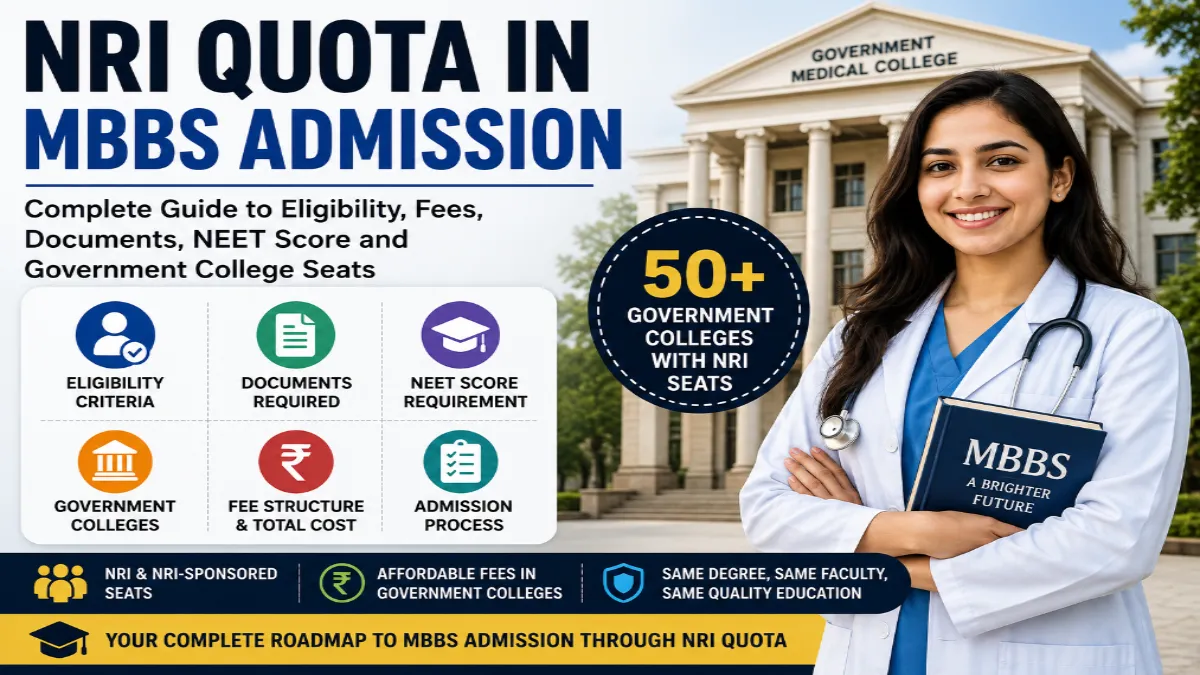
The NRI Quota remains one of the most misunderstood aspects of medical admissions in India. It is often associated with exceptionally high tuition fees and is frequently perceived as an option available only to a select group of candidates. In reality, the NRI Quota is a recognized admission category with specific eligibility requirements and regulations.
For eligible students, it can provide an additional opportunity to secure admission to medical colleges across the country. Therefore, understanding its provisions, eligibility criteria, and financial implications is crucial for making well-informed admission decisions.
The NRI quota is a real, legal, well-regulated admission gateway that thousands of Indian families, including those with just one NRI relative settled abroad, use every year to secure MBBS seats in India. And here’s the part that surprises most people: many of these seats are in government medical colleges.
This guide is going to walk you through everything. What the quota is, who qualifies, who can sponsor you, what documents you need, which government colleges actually have these seats, how much it all costs, and exactly how the admission process works step by step.
Let’s start from the very basics.
What is the NRI Quota in MBBS?
Medical college seats in India are allocated through various admission categories, each designed to serve different groups of candidates. The majority of seats are filled through the General Merit category, where admission is primarily based on a candidate’s NEET score.
In addition, seats are distributed under the State Quota, Management Quota, and Reserved Categories, each with its own eligibility criteria and admission process. Understanding these categories is essential for students to identify the admission opportunities available to them during the counselling process.
The NRI quota is one of those categories. It’s a set of seats in both government and private medical colleges that are reserved specifically for:
- Non-Resident Indians (NRIs) Indian citizens living abroad
- Overseas Citizens of India (OCI card holders)
- Persons of Indian Origin (PIO card holders)
- And crucially Indian students whose close NRI relative is willing to sponsor their education
That last point is what makes this quota accessible to far more families than most people realise. You don’t have to be an NRI yourself. If your father, mother, grandparent, uncle, aunt, or even a first cousin lives abroad and qualifies as an NRI, you could potentially claim a seat under this category.
This quota isn’t some informal arrangement either. It’s recognised by the National Medical Commission (NMC), regulated by the Medical Counselling Committee (MCC) and state medical education bodies, and has been defined and upheld through Supreme Court rulings.
So Why Does This Quota Exist?
Two reasons,
- One is that the Indian government wanted to give NRI families a structured way to send their children back to India for medical education. Many Indian families settled abroad still have deep roots here and want their kids to study and eventually practise medicine in India
- The second reason is financial. Medical colleges are expensive to run. NRI quota students pay higher fees than general merit students. That extra revenue helps colleges fund infrastructure, equipment, and faculty without raising costs for everyone else.
it’s a win for the institution and a win for families who can access quality medical education through a less competitive route.
How Is It Different from a Regular MBBS Seat?
Here’s a simple comparison so you can see the difference clearly:
| Feature | General Merit Seat | NRI Quota Seat |
|---|---|---|
| Who’s competing? | Every NEET student in India | Only NRI-eligible applicants |
| How tough is the competition? | Extremely tough lakhs of students | Much smaller pool |
| Is NEET required? | Yes | Yes no exceptions |
| Annual fee in govt colleges | ₹15,000-₹50,000 | ₹2.5 lakh-₹6 lakh (most states) |
| Annual fee in private/deemed colleges | ₹5-15 lakh | ₹15-40 lakh+ |
| Who handles counselling? | MCC / State DME | MCC NRI round / State NRI counselling |
The biggest real-world difference? The competition. A student who might need a NEET rank of under 10,000 to get into a government college through general merit could potentially get into the same college through the NRI quota with a rank of 70,000 to 1,00,000 because they’re only competing against other NRI-eligible candidates, not the entire country.
P1 vs P2- This Is the Part Most Families Get Confused About
Before anything else, you need to understand these two terms. They define which type of NRI quota candidate you are, and everything from your allotment priority to which colleges are available to you depends on this.
Priority 1 (P1) You or Your Parents Are the NRI
This is the straightforward case. Either the student themselves is an NRI (they live abroad), or their parents are NRIs and the student is their direct child.
P1 candidates get first preference in seat allotment. When counselling happens and seats are being given out, P1 students are placed before anyone else. States like Goa and Punjab commonly follow this system.
Priority 2 (P2) You Live in India, but a Relative Abroad Sponsors You
This is the route that most Indian families actually use. The student lives and studies in India they may have never even visited the country their sponsor lives in. But they have a qualifying NRI relative a parent, grandparent, sibling, uncle, aunt, or first cousin who agrees to financially sponsor their MBBS education.
The sponsor’s NRI status is what matters here. The student’s own location is completely irrelevant for P2 eligibility.
P2 candidates are considered for seats after P1 candidates in each counselling round. But here’s the thing in states like Rajasthan and Haryana, there are so many government college NRI seats that P2 students regularly secure government college admissions.
| Question | P1 – Pure NRI | P2- NRI-Sponsored |
|---|---|---|
| Does the student need to live abroad? | Yes | No |
| Who holds NRI status? | The student or parent | The sponsor (a relative) |
| Allotment priority | First | After all P1 candidates |
| Most common in states | Goa, Punjab | Rajasthan, Haryana, Karnataka |
| Who can be sponsor? | Parent or student themselves | Extended family, including cousins |
Who Is Eligible? Let’s Break It Down Properly
What the Student Needs to Qualify
No matter which category you fall under P1 or P2 as the student, you must personally meet every single one of these requirements:
| Requirement | What You Need |
|---|---|
| Age | At least 17 years old by December 31 of the admission year |
| Subjects in Class 12 | Physics, Chemistry, Biology or Biotechnology, and English — all as core subjects |
| Minimum marks in Class 12 | At least 50% aggregate in PCB (Physics, Chemistry, Biology) |
| NEET-UG | Must have cleared NEET with the minimum qualifying percentile for your category |
| NRI connection | Either be an NRI/OCI/PIO yourself, or have an eligible NRI sponsor |
What Do NRI, OCI, and PIO Actually Mean?
You’ll see these three terms used constantly in the context of the NRI quota. Here’s what each one means in plain language:
NRI (Non-Resident Indian): An Indian citizen who has an Indian passport and lives outside India for 182 days or more in a year. Most NRI sponsors fall into this category think of your uncle in the UK or your father working in Dubai.
OCI (Overseas Citizen of India): Someone of Indian origin who has taken foreign citizenship but has been granted OCI status by the Government of India. OCI holders get a lifelong visa and most rights of Indian citizens. In most states, an OCI card holder can sponsor an MBBS candidate just like an NRI can.
PIO (Person of Indian Origin): Someone who holds or held an Indian passport at some point, or whose parents or grandparents were Indian citizens. The PIO card has largely been merged into OCI now, but many states still recognise valid PIO card holders for sponsorship purposes.
Who Can Be Your NRI Sponsor?
This is where a lot of families get tripped up. They assume only a parent can sponsor or they assume any NRI relative will do. Neither is fully correct.
The list of eligible sponsors is defined by law, including through the Supreme Court’s ruling in the Anshul Tomar vs. State of Madhya Pradesh case. Here’s who qualifies:
First-Degree Relatives (Closest, Highest Priority)
- Your mother
- Your father
- Your real (biological) brother
- Your real (biological) sister
Second-Degree Relatives (Also Eligible)
- Your paternal grandparents – your father’s parents
- Your maternal grandparents – your mother’s parents
- Your real paternal uncle or aunt – your father’s brother or sister
- Your real maternal uncle or aunt – your mother’s brother or sister
- Your first cousins – the children of your parents’ real siblings, on both sides
One important thing: the sponsor has to have been involved in your life as a guardian figure. During counselling, you may be asked to show evidence that this person genuinely looks after you a simple family connection on paper isn’t always enough. This comes under the Guardians and Wards Act, 1890, and states take it seriously, especially for second-degree relatives.
What Does the Sponsor Actually Have to Do?
Being a sponsor isn’t just a formality. The sponsor takes on legal and financial responsibility. They need to:
- Actually reside outside India for at least 182 days a year (hold valid NRI, OCI, or PIO status)
- Sign a formal, notarised affidavit promising to pay the entire course fee and living expenses for the full 5.5-year MBBS programme
- Show proof of an NRE (Non-Resident External) bank account in India — this confirms they have the financial capacity to support you from abroad
- Get an NRI Certificate from the Indian Embassy or Consulate in their country
NEET and the NRI Quota : What Score Do You Actually Need?
NEET Is Non-Negotiable
Let’s get this out of the way first: NEET is mandatory for every NRI quota candidate. No exceptions. No alternative exam. No waiver based on how much the sponsor is willing to pay. You clear NEET or you don’t get in it’s that simple.
Why There’s No Single “Cutoff Number” Anyone Can Give You
If you’ve been searching “NRI quota NEET cutoff 2025” and getting frustrated because you can’t find a clear answer here’s why: there isn’t one fixed number. The cutoff shifts every single year based on how tough the NEET paper was, how many NRI-eligible students applied, and how many seats were available in a given state.
What does stay consistent is the principle: NRI quota cutoffs are much lower than general merit cutoffs, because you’re competing against a much smaller group of people.
How It Actually Works in Practice
Once you’re declared eligible for NRI quota counselling, your NEET rank is compared only against other NRI-eligible candidates not against the entire country of NEET test-takers. That’s the real advantage.
But here’s the nuance: the P1/P2 priority system plays a role too. A P1 candidate with a lower NEET score will be given a seat before a P2 candidate with a higher score in the same round, because P1 has priority. Your score matters, but your category matters alongside it.
What Type of College Can You Expect at Your Rank?
Based on historical trends across counselling rounds, here’s a rough picture:
| Institution Type | Typical NRI Pool Rank Range | Annual Fee |
|---|---|---|
| Govt college Rajasthan, Haryana | Competitive within NRI pool; higher score needed | ₹2.5-6 lakh |
| Govt college Karnataka, Maharashtra | Moderately competitive | ₹6-25 lakh |
| Private medical college | Moderate | ₹10-25 lakh |
| Deemed university | Lowest cutoff in the quota | ₹25-40 lakh+ |
Students with a NEET rank beyond 1,50,000 typically find their realistic options in deemed universities through the NRI quota. Government college NRI seats especially in Rajasthan are more competitive within the NRI pool because the fees are far lower and demand is high.
Government Medical Colleges With NRI Quota The List Most Families Don’t Know About
Here’s the thing nobody tells you: the NRI quota isn’t just for expensive private colleges. Right now, more than 52 government medical colleges across India offer NRI or NRI-sponsored seats.
Same faculty. Same government hospital clinical training. Same MBBS degree just at a higher fee than what regular state-quota students pay, but a fraction of what private or deemed colleges charge.
Rajasthan 27 Government Colleges (The Biggest Opportunity in India)
No state comes close to Rajasthan when it comes to government NRI seats. With 27 government medical colleges offering NRI-sponsored (P2) seats, this is the go-to destination for most P2 families.
Note: Rajasthan remains one of the most preferred states for NRI-sponsored MBBS admissions due to the large number of government medical colleges offering NRI quota seats. Students interested in applying through Rajasthan state counselling can refer to detailed guide on the Rajasthan NRI Quota MBBS Admission Process, Eligibility, Documents, Seat Matrix, and Counselling Procedure for complete information.
Some of the key colleges include:
- SMS Medical College, Jaipur one of the most reputed government medical colleges in North India
- RUHS College of Medical Sciences, Jaipur
- RNT Medical College, Udaipur
- Government Medical College, Kota
- Dr SN Medical College, Jodhpur
- JLN Medical College, Ajmer
Annual NRI fee: approximately ₹2.5 to ₹5 lakh at most colleges. Some institutions in Rajasthan charge higher up to ₹24 lakh annually. Always verify the exact fee with the individual college or the Rajasthan DME notification for that year.
Admission here happens through Rajasthan state DME counselling — not through MCC.
Haryana 8 Government Colleges (The Hidden Gem)
Education consultants often call Haryana an “overlooked” state for NRI-sponsored government seats. Eight government colleges here offer P2 seats, including institutions in Rohtak, Karnal, and Sonipat.
Fee information varies between sources and between colleges — some report figures as low as ₹28,000 annually while others cite much higher amounts in USD. Given this inconsistency, always verify directly with the Haryana DME before using any number for financial planning.
Karnataka 5 Government Colleges
Karnataka has five government colleges with NRI seats in Mysore, Bellary (VIMS), and Hassan. Admission goes through KEA (Karnataka Examinations Authority) based strictly on NEET rank within the NRI pool.
Annual NRI fee in these government colleges: approximately ₹25 lakh higher than Rajasthan or Haryana, but still well below most deemed universities.
Maharashtra
A limited number of government college NRI seats exist here, managed through DMER (Directorate of Medical Education and Research) counselling. Grant Medical College, Mumbai is among the notable institutions. Annual fees are roughly ₹3–6 lakh.
Kerala
Very limited NRI seats in government colleges primarily at Government Medical College, Thiruvananthapuram. These are among the most competitive NRI seats in the country. Kerala’s government colleges have a strong national reputation, so demand within the NRI pool is high.
Other States Worth Knowing About
NRI quota seats both in government and private colleges also exist in:
- Uttar Pradesh including King George’s Medical University (KGMU), Lucknow
- Delhi
- Chandigarh
- Pondicherry
- Himachal Pradesh
Government Medical Colleges Offering NRI Quota Seats in India
Many students and parents believe that the NRI quota is available only in private medical colleges. However, this is not true. Several government medical colleges across India also offer NRI or NRI-sponsored seats.
These colleges provide the same MBBS degree, faculty, hospital training, and clinical exposure as regular government seats. While the fees are higher than the state quota, they are often significantly lower than those charged by private and deemed universities.
The table below provides a quick overview of major states offering government MBBS seats under the NRI quota.
| State | No. of Government Colleges with NRI Seats | Notable Colleges | Approximate Annual NRI Fee | Counselling Authority |
|---|---|---|---|---|
| Rajasthan | 27 | SMS Medical College Jaipur, RUHS Jaipur, RNT Udaipur, GMC Kota, Dr. SN Medical College Jodhpur | ₹2.5–5 lakh | Rajasthan DME |
| Haryana | 8 | Government Medical Colleges in Rohtak, Karnal, Sonipat and others | Varies by college | Haryana DME |
| Karnataka | 5 | Mysore Medical College, VIMS Bellary, Hassan Institute of Medical Sciences | Around ₹25 lakh | KEA |
| Maharashtra | Limited Seats | Grant Medical College Mumbai and select government colleges | ₹3–6 lakh | DMER Maharashtra |
| Kerala | Limited Seats | Government Medical College Thiruvananthapuram | ₹2.5–5 lakh | Kerala CEE |
| Uttar Pradesh | Limited Seats | KGMU Lucknow and select institutions | Varies | State Counselling |
| Delhi | Limited Seats | Select government institutions | Varies | State/Central Counselling |
| Chandigarh | Limited Seats | Government medical institutions | Varies | State Counselling |
| Puducherry | Limited Seats | Government medical colleges | Varies | CENTAC |
| Himachal Pradesh | Limited Seats | Government medical colleges | Varies | State Counselling |
Note: Fee structures may change every year. Candidates should verify the latest fee details through the official counselling authority before applying.
What Will It Actually Cost? The Full Fee Breakdown
Government College Fees at a Glance
| State | Annual NRI Tuition Fee | Approx. Total Over 5.5 Years |
|---|---|---|
| Rajasthan | ₹2.5–5 lakh | ₹14–28 lakh |
| Maharashtra | ₹3–6 lakh | ₹16–33 lakh |
| Kerala | ₹2.5–5 lakh | ₹14–28 lakh |
| Karnataka (govt) | ~₹25 lakh | ~₹1.4 crore |
| Haryana | Verify with DME | — |
Private and Deemed University Fees
| Institution Type | Annual NRI Fee | Total Over 5.5 Years |
|---|---|---|
| Private medical college | ₹10–25 lakh | ₹55 lakh–₹1.4 crore |
| Top deemed university | ₹25–40 lakh+ | ₹1.4–₹2.2 crore+ |
Don’t Forget the Hidden Costs
The tuition fee is just one part of what you’ll spend. Every year, there are additional costs that families sometimes forget to plan for:
| Expense | Estimated Annual Cost |
|---|---|
| Hostel and mess | ₹1.4–3.2 lakh |
| Books and study material | ₹20,000–50,000 |
| Exam and university fees | ₹15,000–40,000 |
| Travel and personal expenses | ₹80,000–2.2 lakh |
| Total additional costs per year | ₹2.5–6 lakh |
Over the full 5.5 years, these additional costs alone can add anywhere from ₹14 lakh to ₹33 lakh on top of your tuition. Include this in your financial planning from day one don’t just look at the tuition fee in isolation.
Why a Government College NRI Seat Is Worth Fighting For
The numbers tell the story clearly. A Rajasthan government college might cost ₹2.5 lakh per year in tuition roughly ₹14 lakh total. A top deemed university under the NRI quota might cost ₹35 lakh per year nearly ₹2 crore over the same duration. That’s a difference of close to ₹1.8 crore for the same MBBS degree.
And it’s not just about money. A government medical college degree generally carries more weight when it comes to NEET-PG (postgraduate entrance), hospital appointments, and international medical licensing. Government hospitals attached to these colleges also see far higher patient volumes, which means richer, more varied clinical experience during your training years.
Documents Required :The Complete Checklist
This is the section most families underestimate. Document preparation is where applications most commonly go wrong an expired certificate, a missing notarisation, or the wrong type of relationship proof can get your application rejected at the counselling stage, no matter how good your NEET score is.
Here’s everything you need.
What the Student Must Submit
| Document | What to Note |
|---|---|
| NEET-UG Admit Card | Original + photocopy |
| NEET-UG Score Card | Original + photocopy |
| Class 10 mark sheet and certificate | Board-certified copies |
| Class 12 mark sheet and certificate | Board-certified copies |
| Birth certificate | Clear proof of date of birth |
| Transfer Certificate (TC) | From last school or college attended |
| Migration Certificate | If applicable |
| Passport-size photographs | As per counselling authority specifications |
| Proof of residential address | Aadhaar card, utility bill, or equivalent |
What the NRI Sponsor Must Submit
| Document | What to Note |
|---|---|
| Valid Indian passport | Certified photocopy — must include visa and immigration stamps showing time abroad |
| Valid visa / work permit / residence permit | Must be current and valid at the time of application |
| NRI Certificate | Obtained from the Indian Embassy or Consulate in the sponsor’s country — valid for 6 to 12 months from date of issue |
| OCI or PIO card | If sponsor holds OCI or PIO status rather than standard NRI |
| Proof of living abroad (182+ days) | PR card, work permit, landing paper, or official residence document |
| Notarised affidavit of sponsorship | A formally notarised legal commitment to pay all fees and living costs for the full MBBS programme |
| NRE Bank Account Passbook | Copy of the sponsor’s Non-Resident External bank account — proves financial capacity |
| PAN Card | Required by some states |
| Proof of address abroad | Current utility bill or official address proof from the country of residence |
Relationship and Guardianship Proof
| Document | What to Note |
|---|---|
| Relationship certificate | Issued by a Revenue Authority formally establishes the blood relationship between sponsor and student |
| Family tree document | Required by most states alongside the relationship certificate |
| Proof of legal guardianship | For P2 candidates evidence the sponsor has acted as the student’s guardian under the Guardians and Wards Act, 1890 |
Pay special attention to this: The NRI Certificate from the Embassy is probably the single most important and most mishandled document in this entire process. It’s only valid for 6 to 12 months from the date of issue. Families often get this done a year in advance, thinking they’re being organized, only to find it has expired before document verification begins. Get it two to three months before counselling is scheduled to open, not earlier.
The Admission Process What Happens After NEET, Step by Step
Step 1: Qualify NEET-UG
Every candidate applying under the NRI quota must qualify NEET-UG with the minimum percentile prescribed by the NTA.
Step 2: Register for Counselling
Register with the appropriate counselling authority. MCC handles deemed universities, while state authorities manage government and state private college NRI seats.
Step 3: Submit Documents
Upload and verify all required documents, including NEET score card, NRI Certificate, sponsorship affidavit, and relationship proof.
Step 4: Fill College Choices
Select and arrange your preferred colleges and courses based on your NEET score, budget, and admission chances.
Step 5: Seat Allotment
Seats are allotted through multiple counselling rounds based on NEET rank, NRI eligibility, and seat availability.
Step 6: Accept the Seat
If allotted a seat, confirm your admission within the given deadline to avoid losing the allotment.
Step 7: Pay Fees
Pay the prescribed tuition fee and complete any additional formalities required by the counselling authority.
Step 8: Report to the College
Visit the allotted college with all original documents for final verification and completion of admission procedures.
Mistakes That Have Cost Real Students Their Seats
These aren’t hypothetical warnings. These are patterns that repeat every single counselling cycle.
Getting the NRI Certificate too early. It’s valid for 6–12 months. Getting it in January when counselling opens in August means it may expire before your documents are verified. Time it right.
Using a relative who doesn’t actually qualify. Step-relatives, in-laws, and distant connections not covered under the first or second-degree list are not valid sponsors. Confirm eligibility before building your entire application around a particular person.
Not gathering relationship documents in time. Revenue authority certificates and family trees take time to collect, especially when family members are spread across states or abroad. Start this process early don’t leave it for the last few weeks before counselling.
Applying through the wrong counselling body. Going to MCC when your target colleges are under state counselling means you’ve wasted an entire round. Map every college to its counselling body before you begin.
Affidavit not properly notarised. In many cases, the affidavit needs to be notarised in the country where the sponsor lives not in India. An improperly notarised document gets rejected without exception.
Trusting random online fee information. Fees listed on third-party websites including many well-meaning education portals are often outdated or wrong. Always verify the current year’s fee directly through the college’s official notice or the state DME’s official counselling notification.
Missing the seat acceptance deadline. You get one shot to accept. If you’re traveling, in a different time zone, or just not checking that seat is gone. Set alarms. Check the portal daily during allotment periods.
FAQs
My parents are Indian citizens living in India. Can I still apply?
Yes, but only If you have a qualifying relative a grandparent, uncle, aunt, or first cousin who lives abroad and holds NRI, OCI, or PIO status and is willing to formally sponsor you, you are eligible as a P2 candidate. Your parents’ status has no bearing on this.
Does the student need to have ever lived abroad?
No. For P2 candidates, the student’s own location is completely irrelevant. The NRI status requirement applies to the sponsor, not to you.
What is the actual minimum NEET score for the NRI quota?
There’s no single number it changes every year. The floor is the NTA qualifying percentile for your category. Beyond that, how competitive you are depends on how your rank compares to other NRI-eligible applicants in that year’s pool. Government college NRI seats need a higher rank within the NRI pool than private or deemed college NRI seats.
Can I apply to both MCC counselling and state counselling at the same time?
es. Many families register with both MCC (for deemed colleges) and one or more state counselling bodies (for government and state private colleges). They run on parallel but separate timelines. This maximises your options
Is the NRI quota available in AIIMS?
AIIMS has no NRI Quota
Everything at a Glance Quick Reference Table
| Topic | What You Need to Know |
|---|---|
| What is it? | Reserved MBBS seats for NRI/OCI/PIO individuals and their sponsored relatives |
| NEET mandatory? | Yes absolutely no exceptions |
| Two categories | P1 (student/parent is NRI) and P2 (Indian student with NRI sponsor) |
| Who can sponsor? | Parents, siblings, grandparents, real uncles/aunts, first cousins |
| Government colleges available | 52+ across India Rajasthan alone has 27 |
| Best states for govt seats | Rajasthan, Haryana, Kerala, Maharashtra |
| Govt college annual fee | ₹2.5-6 lakh (most states); ~₹25 lakh in Karnataka |
| Private/deemed annual fee | ₹10-40 lakh+ |
| Additional living costs | ₹2.5-6 lakh per year on top of tuition |
| Most time-sensitive document | NRI Certificate from Embassy only valid 6-12 months |
| Counselling routes | MCC for deemed/central; state DME/KEA/DMER for govt and state private |
| Legally valid? | Yes NMC regulated, Supreme Court recognised |
| Biggest risks | Expired NRI Certificate, wrong counselling body, missed acceptance deadline |
All information in this guide is based on NMC regulations, MCC guidelines, state DME notifications, Fees, eligibility conditions, and counselling processes are revised every year by the respective authorities. Always cross-check with the latest official notification from the relevant counselling body before taking any admission decision. This article is for informational purposes only and does not constitute legal or financial advice.
Need Help with NRI Quota MBBS Counselling? Connect with admission experts for personalised guidance on eligibility, documents, counselling, and college selection.https://rmgoe.org/